Thursday, March 5, 2009
Higgs boson found!
It's been found by three gradeschool kids with an accelerator they build in the hallway of their junior high school. Really. It's on the Interwebs, so it has to be true, right? Read all about it. CERN and Fermilab researchers are rumored to be considering "chucking it all in and starting a band."


Tuesday, February 17, 2009
50/50 at worst, 96% at best
These are the odds that Fermilab will find the Higgs before CERN. At least, according to Fermilab, as quoted today in this article from BBC News. The subhead of the article reads "Europe's particle physics lab, CERN, is losing ground rapidly in the race to discover the elusive Higgs boson, or "God Particle," its US rival claims."
Later in the article comes this line:
"Project leader Lyn Evans conceded the enforced downtime might cost the European lab one of the biggest prizes in physics."
I've mentioned before that Ben Kilminster, wearing his batman T-shirt, half-jokingly said that Fermilab was in a race with CERN but they needed CERN to "trip a little bit. Stumble." Back when CERN had its breakdown, in the fall of 2008, I don't think anyone expected the ramifications to be quite so huge. Remember, some people say that the entire construction of this new version of CERN was done to find the Higgs. Others will point out that there is much more science that will be done than that one discovery, but no one could deny that the Higgs is a main motivator. So when it became apparent that CERN was out of commission for a full year, I suspect the worrying began. This wasn't CERN tripping a little bit; a stumble. This was turning out to be a headlong sprawl.
As Leon Lederman, John Conway, and others said in our film, the Tevatron is now a finely-tuned, thoroughly tested race car, purring along on eight cylinders, with a pit crew of battle-hardened mechanics standing by who know every nut and bolt by heart. If ever there was a moment for it to take the lead and claim the prize, this is it.
The article states something quite stunning:
"Fermilab estimates that the Tevatron has already picked out about eight collision events which may be hints of the Higgs."
Sounds like there's a potential that by summer this could finally be in the bag... stay tuned for further developments...
Friday, February 6, 2009
New Hampshire Public Radio
And here's a link to a slightly more erudite interview Monica did with New Hampshire Public Radio's Word of Mouth show. They do a really nice job of introducing the story, including playing some clips from the film like they did at our Chicago NPR show (but they get monica's last name wrong. It's the price of fame.)
Grok
Here's a link to a rather lengthy interview I did for an online science radio show called Groks Science Radio. At the end of the interview, they asked if I'd like to play a game called Grokatron 5000. This is where they ask a question, generated by their super computer (ahem). The question was "Massive or Insubstantial?" I was asked to rate each of 5 people as being either massive or insubstantial. The five people were: Bill Gates (windows = insubstantial, but philanthropic work = massive). Jerry Springer (again, first half of his life in politics = massive, TV show = insubstantial), Stephen Hawking (massive, of course), Paris Hilton (insubstantial), George Bush (unfortunately massive).
Why? Because the Grokatron asked. I answered.
Why? Because the Grokatron asked. I answered.
Friday, January 30, 2009
Tuesday, January 27, 2009
Talkback!
The Atom Smashers is broadcasting again tonight (Tuesday, January 27th) in an encore showing on many PBS stations. We found out from PBS that the film is screening in the Los Angeles area for the first time tonight, as they were in the midst of a pledge drive in November when it originally aired. So, to any west-coasters, welcome! And to everyone, please visit the PBS "Talkback" page to write your thoughts about the film. And please visit here to buy your very own copy (an extended version with 6 extra features), and we'd love to discuss setting up a screening with your school, museum, lab, club, or whatever organization you've got.
Sunday, January 25, 2009
Ghostly congratulations

Great news for our esteemed soundtrack composer, Kate Simko (and us, indirectly): The Atom Smashers soundtrack will be released on Ghostly Records! Kate has a great career going as a composer and performer, and I've gotten so many compliments about the soundtrack of the film that I can't forward them all to Kate. I wrote about the collaboration I had with her here and I'm really excited to see this album come out! it represents what I think is the best part about collaborations: two things that are symbiotically created (a movie and the movie's soundtrack) but that have identities and lives beyond and above the relationship between them. OK, I'm not sure how much a life our film would have without its soundtrack, but you get the idea.
I'm not sure when this will be ready for sale (they're still working on details like cover art, etc) but you can be sure I'll post about it and there will be a link to buy it from our website.
[PS - 1/28 I've just heard a preview copy of the CD --- it sounds fantastic. - cb]
Friday, January 23, 2009
Watch it again!
The Atom Smashers will air again on PBS this Tuesday, January 27. This time around it will be at 10PM instead of 10:30, so hopefully some early-risers might have a chance. PBS is not doing anything to promote this screening, since it's basically a freebie (meaning it was a repeat that they didn't expect during the contract negotiations. We prefer to call it an "encore presentation.") For this broadcast, we managed to change a bit of text at the very end to recognize the shutdown of CERN. Check your local listings here.
Since my last post we've had a couple more festivals (one in Greece, one in Belgium) invite the film to screen (not us, just the film, alas), and Monica and I are very excited to be flying out to show the film at UC Davis where John and Robin teach sometime in April.
And here's something I find personally very exciting: it's fun to see our film listed on Netflix! We've got an average rating of 3.5 stars. So far we're not appearing on itunes, but that should happen eventually.
And finally, a funny anecdote, from Robin:
John and I had our first encounter with a "fan" at LAX on the way back from Taipei. We were changing gates to transfer to Sacramento and a guy (early 30s? late 20s?) stopped us and said "Hey! I just saw you in a movie!". Unfortunately he couldn't remember right then what it was, though we didn't give him a moment before we told him it was the Atom Smashers. I'm also not sure whether his star search feelers were out due to being in Los Angeles or something. :)
Anyway, he asked us how things were going with our project and such, then we went on our way.
Thanks, Andrew/Monica/Clayton, for our >15 minutes of fame. *grin*
I wrote back to say that one of my goals in life is to have more physicists signing autographs.
Tuesday, December 16, 2008
Change and Progress

When we had our panel discussion following the screening of The Atom Smashers at the Museum of Science and Industry, John Conway talked about the cautious optimism they were feeling about Barack Obama. So far, I can only imagine John and others are pinching themselves to make sure they're not dreaming. First of all, he has answered lots and lots of science questions, and many of them substantially. "This is the first time we know of that a candidate for president has laid out his science policy before the election at this level of detail," says Shawn Otto, CEO of ScienceDebate2008, as quoted in this Wired article. Otto goes on to say that he "thought they were very substantive for this point in the campaign, and surprisingly detailed."

And John mentioned one thing in particular: Obama clearly stated that his administration "will increase funding for basic research in physical and life sciences, mathematics and engineering at a rate that would double basic research budgets over the next decade."
Doubling is good!
But just as important as many of those detailed answers about policy, and perhaps moreso, are some statements that indicate the huge ideological shift that will take place. Consider the fact that he believes the restrictions on human embryonic stem cell research "have handcuffed our scientists and hindered our ability to compete with other nations."
And this: "I will restore the basic principle that government decisions should be based on the best-available, scientifically valid evidence and not on the ideological predispositions of agency officials or political appointees."
And this, said just yesterday: "my administration will value science, we will make decisions based on the facts, and we understand that the facts demand bold action."

When did he say this? During the announcement that he was appointing Dr. Steven Chu, a Nobel Prize-winning physicist, as the Secretary of Energy. And, yes, the Department of Energy is the funding agency for ... Fermilab. And Fermilab is happy... here's what Pierre Odonne, head of Fermilab (and someone we interviewed twice) has to say about it:
President-elect Obama’s nomination of Steve Chu to head the Department of Energy is an exciting prospect for us within the community of DOE national laboratories. For the first time in the history of the DOE, a distinguished physicist has been nominated to take the helm. Steve Chu shared the 1997 Nobel Prize in physics and is currently the director of Lawrence Berkeley National Laboratory. He is passionate about science. Even while serving as laboratory director he has kept a very active research program with students and post-docs, inquiring into fundamental processes in cell biology using new molecular and atomic techniques. One has to go back 50 years to the DOE’s grandparent agency, the Atomic Energy Commission and the leadership of Glenn Seaborg to find a scientist of such distinction at the helm.
Talk about change and progress!
Sunday, December 14, 2008
Today PBS, tomorrow the world
When I was in Bergen for the Bergen International Film Festival, just as I was finishing my lutefisk, Paul Devlin (a fellow science doc filmmaker who has made a very successful film called "Blast") mentioned to me that there were some international distributors at the next table. I had a good conversation with one of them and attended a panel discussion where she was speaking, and learned quite a bit about getting a film ready for international distribution. Truth is, we had thought vaguely about it, but didn't really put a whole lot of thought into it.
Things I learned:
1. International outlets rarely want anything over 1 hour. Most American filmmakers aim for the feature, and the first hard hurdle is the realization that they're going to have to cut their baby to fit a 54-ish minute time slot. Luckily for us, we already jumped this hurdle and had our 53:30 cut ready to go.
2. There are many countries who do not subtitle foreign films. They dub them. Yes, that's right. Cultural issues, literacy issues, lot of different things mean you have to prepare your film to be dubbed into many different languages. How do you do this? You have to prepare what's called an M & E track (music and effects). This means you need to have your sound mixer work some magic on the edit: all the dialogue has to be pulled, but background sounds, music, sound effects, and everything else has to be left in. It makes me really curious to know how the dubbing is done. Do they hire a team of actors to play the different parts? Or do they just have one man and one woman who do it all? Do they just read the text, or do they... act?
A strange example of the expectations of dubbing can be found in the incredible film "I Am Cuba," which isn't exactly a documentary (but has been called a "poetic documentary"). This is a Russian film made in 1964, celebrating the communist revolution in Cuba. It is breathtakingly beautiful, but in the versions I've seen is quite a mind-bender in terms of its language: it was shot silent, then overdubbed with Spanish. However, a deep-voiced Russian "narrator" then repeats each line in a sonorous tone, whether the Spanish speaker was a man or a woman. Finally, on top of it all, are English subtitles. Whew.
So, the M&E tracks are placed on the master tape that you deliver. There are 4 sound channels on a master tape: 1 and 2 are for the regular stereo mix (in English) and 3 & 4 are for the M&E tracks. The broadcaster can access whichever they want.
3. For those countries who DO want to use subtitles, you have to also give them a version of the film that has no English text. Well, not actually the full version. On the same broadcast master, after the film ends, you insert blank versions of all the shots from the film that had text on them. These are called "textless elements," and are usually separated by a second or two of black. That way some lowly broadcast intern in the Czech Republic or Finland or Peru can insert the clean shots and slap their own subtitles on.
For example, our film has quite a few lines of text pointing out this or that fact or development. In addition, every once in a while a date will appear, and certainly everyone who speaks gets a name and ID (incidentally, these last are called "lower thirds"). All of those shots have to be provided at the end of the tape without any text on them.
4. Finally, the last thing to do is to convert your show to the PAL format. We in the US and Canada use NTSC, but in Europe and many places overseas PAL is the standard. What the heck are NTSC and PAL? I won't give you a technical answer (I do that in my classes at Northwestern) but here's the gist of it: imagine if two different cultures had the same idea and worked it to completion independently of each other. The end result would be the same, but the methodology would likely be completely different. That's the way it happened with video. They both work but they are utterly incompatible. Different frame rate, different size, different way color is encoded.
So, after that technical sidebar, back to my story: The woman I spoke with in Bergen took home a dvd and a few days later she indicated her company was interested in the possibility of distributing it internationally. Exciting! But it turns out they wanted a rather radical re-cut, in essence creating an entirely different film. We thanked them but passed.
Not long after, we got an email and a phone call from a Toronto-based company who had seen the film at the Pariscience festival (where it won the Audacity Award!). They were very interested, and in fact interested in moving fast because there was something called the "World Congress of Science Documentary" that they wanted to take our film to. To make a long story short (sorry, too late), we went into high gear and inked an international distribution deal!
So what have I been doing lately? You guessed it: creating M&E tracks and preparing textless elements. Soon I'll be able to send off the file to the post house for them to create the NTSC and PAL masters, and then... who knows? The Atom Smashers might be beaming into households from New Zealand to Iceland. A few days ago the distributor said "we've been inundated with requests for screeners." I like that word, inundated.
Wednesday, December 10, 2008
How'd you do that shot?
There's a nice thing that can happen when you're making a film, and to some extent you can plan for it, but to a large extent you can't. You can make a great shot, but you can't necessarily imbue that shot with meaning. That has to happen from the rest of the film that surrounds the shot. I've quoted Walter Murch before, and I'll probably do it again, but he said that music in movies should channel the emotions that are already in the scene, not try to install emotion into the scene. It's the same way with a certain shot: it works best if it can channel the emotion (or meaning) that's already present in the film.
Our film is pretty straight-forward in terms of its cinematography. We did have one or two "special effects" shots, one of which I outlined here and here, and the other of which we get asked about fairly often: the rollerblading shot from up above. I wrote about that here.
I teach cinematography (among some other things) at Northwestern University. It's true, we all have day jobs, despite the huge amounts of money that are pouring into our coffers from The Atom Smashers. Ahem. Sorry, I was daydreaming there. In my classes we often look at films and analyze things like color, lighting, camera movement, etc. A lot of times it's fun for us to speculate how a certain shot was achieved. Or a cinematographer will share how something was done in an interview that I assign as a reading.
It's interesting to me that while the cinematographer usually talks about the equipment used, the technical challenges, the film stock and developing procedures, he or she rarely talks about what the shot means, or emotionally how it affects the story (this is not always the case; some cinematographers are very sensitive to this). This kind of reflection usually falls to the director, although for the most part directors in interviews don't like to talk too much about the cinematography, preferring instead to talk about the actors and the story (which is how it ought to be).
So, this does leave a bit of a gap, and I've found that usually only viewers and reviewers are the ones willing and eager to talk about what certain shots actually mean and how they impact us emotionally and metaphorically, and how they fit into the process of telling the story. Only in the genre of documentary (and, specifically, very low-budget documentary) do you find the somewhat unique and clunky combination of "director/cinematographer."
Sometimes, though not as much as I would hope, there are moments when those two pursuits intersect in a way that allows for one person to be thinking of the story and about getting a nice shot at the same time, and an interesting moment will get caught on camera; a moment of reflection that can serve to gather much of the rest of the film up and shine some thought into it, perhaps a new or extended meaning.


We've gotten enough comments about Ben's rollerblading sequence to make me think perhaps this may have happened in our film. Hi Kooky, a regular commenter on this blog with her own great blog, wrote a nice email to me and called that rollerblading sequence a "transforming moment." Our film was barely underway when we shot that sequence, so there was really no way to know if it would even make it into the final product or not. But a strange combination of the complexity of the search as reflected in Kate Simko's music, Ben's optimism, his musing about how funny it is to need something so big to see something so small, and then that nice shot that Stefani Foster nailed on the first take where Ben keeps getting smaller and smaller and the ring gets bigger and bigger --- a perspective shift happens. Maybe it is a transforming moment in that way.
Or maybe it's just a neat shot. It's hard to tell. I do remember thinking, I'll have to admit, when Stef finished the tilt up and zoom out from Ben on the rollerblades, "wow, it's fun to make documentaries."
Sunday, December 7, 2008
Audience Award
Hey --- if you're so inclined, vote for The Atom Smashers for the PBS Audience Award!
Saturday, December 6, 2008
CERN in the news
This article by Dennis Overbye of The New York Times gives an update on when the LHC is going to start back up. They say that they could be doing a more limited series of collisions by next August, but won't be up to full power for some time after that. Some say this is an optimistic timeline.

If you saw our film, you remember Ben Kilminster near the end, wearing his Batman T-shirt, re-iterated that Fermilab and Cern were in "kind of a bit of a race" to find the Higgs, and that they needed CERN to "trip a little bit --- stumble."
What ended up happening was not just a trip but an all-out head-over-heels tumble. A quick recap: in order to get the protons to go in a circle instead of in a straight line, CERN (and Fermilab) use gigantic magnets to bend their trajectory. How big are these magnets? Each one weighs ... ten tons. (that long orange thing in the picture is one of them...
 in fact, one made at Fermilab and shipped over for use at CERN! See how cooperative they are in their competition?) There are a staggering 1,232 of these magnets. And in order to get them to be really efficient, they cool them way down, to 2 degrees above the temperature of deep space (absolute zero). This makes them "superconducting."

How do they cool them down? With liquid helium, naturally. Really cold stuff.
So, they think an electrical problem caused a spark which punctured the layer of liquid helium, causing it to flood out and expand (when liquid helium under pressure turns into a gas it practically explodes). I'll quote from the article:
The resulting internal pressures shoved some of the magnets off their mounts and crunched the connections between them. The beam pipes that the protons shoot through were also punctured and contaminated with soot. Or as Dr. Gillies said, "It's a mess."
Remember, those magnets weighed 10 tons!
So, they've got a major workload on their hands. As the article says, they have to bring no less that 53 of those 10 ton magnets to the surface (they're 300 feet underground) to inspect them and fix them, and then do tons of checking and evaluating of the whole darn thing.
Good luck, CERN! In the meantime, Ben and company are working away at Fermilab, regretting the difficulties their colleagues in Europe are having (and trying not to rub their hands with glee too much).
Monday, December 1, 2008
Cosmos, and thanks, Monica!
Monica, my co-director, is perhaps the best gift-giver I know. She's given me antique movie cameras, and one Christmas after shooting Marcela Carena's tango club, she gave me ... a tango trophy. First place, no less.

I think I mentioned the TV party we had to watch The Atom Smashers at the Caro D'Offay gallery. Caro and Annie Stone built a cardboard "console" for my modern-looking TV and I projected a video fireplace on the wall next to it, so we all felt as though we were watching TV down in the den. All we needed was some shag carpet.
There's a quick scene in the last quarter of the film where the physicists are discussing why they got into physics. Robin is hanging around in John Conway's office, chatting with John's working group and says she got into physics "because of Carl Sagan." It's one of those nice moments where I think, for once, they truly forgot we were there. She said she had a "mickey mouse" physics class in high school, which didn't inspire her, but once she saw "Cosmos," she was hooked.

She wasn't the only one --- Cosmos riveted me as a kid. I'll be honest: I think Cosmos has been quietly swimming in the back of my mind the whole time we've contemplated making science documentaries. It is clearly a product of a different time, and could never be made today, because ... it's ... slow. Beautifully slow, unhurried, measured, calm, thoughtful. Profound, contemplative, awe-inspiring. Mention any of those words to a documentary distributor or sales agent today, and quite likely you're in real trouble. Mention them in conjunction with the word "science" and you'll get the conversational equivalent of a door slammed in your face.
Our documentary is nothing like Cosmos in that we don't have a narrator or an on-screen presence (Carl Sagan), and we're following a story rather than contemplating the universe at large. But I'd like to think we have a small connection. But before I elaborate, back to my story:
So, we're in the gallery getting ready for the TV party. The cardboard console (complete with big cardboard knobs) is being built, and I'm putting the finishing touches on the video fireplace. Monica arrives, followed by Andrew, who is carrying a FedEx package for me and one for monica. They're from PBS, and we open them to find a nice letter and a box of chocolates! Very nice, and a sweet touch. Then Monica gives me a wrapped package which I immediately open, and find ... a hardbound copy of "Cosmos," by Carl Sagan. Written on the front page:
The Atom Smashers 11-25-08
I got into science because of Clayton Brown! Here's hoping our next story is just as much fun!
Onward, Monica
Tonight I opened the book for the first time, and in Sagan's introduction, a passage leaped out at me. It says:
Cosmos is dedicated to the proposition that the public is far more intelligent than it has generally been given credit for, and that the deepest scientific questions on the nature and the origin of the world excite the interests and passions of enormous numbers of people.
If there was ever a motto for my feelings about our group, 137 Films, this is it. These two beliefs make the backbone of our philosophy, and why we had the nutty idea of making a film about one of the most esoteric, hard-to-fathom scientific concepts out there, brazenly assuming both of Sagan's declarations were true!
I feel like there is a lifetime of exciting work ahead.
So, thanks, Carl Sagan, and thanks, Monica!
See why I say she's such a good gift-giver?

Friday, November 28, 2008
On the air

Here's a great picture snapped by my girlfriend Kristine as Monica and I sat in the very public "showcase studio" at WGN, AM 720, doing an interview with John Williams. It's happening on a couple of different levels: there's the reflection of Michigan avenue, but if you look closely you can see Monica and me behind our microphones. It's literally right on Michigan avenue, so people walk by, peer in at you, make faces, do dances, all while you're trying to keep your head together to give a good definition of what the Higgs boson is. When Kristine pressed against the glass to snap this picture, I dimly understood that someone was taking a picture, but didn't allow myself to look too closely. Consequently, I had no idea it was her.
On quite the opposite spectrum of my single-minded tunnelvision sat John Williams, the DJ / host of the show, who seemed to be wired to a supercomputer in the sky. He carried on a very chatty conversation with us that never stopped during commercial breaks, all the while hearing talkback from a producer over a loudspeaker about the emergency alert system check that was about to happen, how many commercials there would be, what the next guest was, and how many seconds there were to go until we were back on the air. Not only that, but people were strolling through the studio, people on Michigan avenue were tapping on the glass to get his attention, and something seemed to be under repair in the room. Despite all this, he asked some great questions, told us what his idea for what our next film should be (he wanted to find people to give him the formula for true happiness) and waved and made faces for the people outside. When Kristine approached the glass, he actually posed and waved to her without missing a beat in our conversation. When Monica and I left I think we had aged a week in those 20 minutes.
For a slightly more tranquil conversation, Monica and I pre-recorded an interview with Alison Cuddy and producer Joe Deceaux on Chicago Public Radio's "848" morning show. We spoke for about 20 minutes, and they edited it down to about 10. They also did a terrific job of splicing in audio moments from the film to illustrate and enhance the conversation. We were really pleased with it.
And, just like that, our brief but exciting media frenzy is over! The film will air again January 27, so hopefully we'll get another round of attention. More about what comes next in the next post...
Wednesday, November 26, 2008
Another guest post
A post from Mark Oreglia. Thanks, Mark!
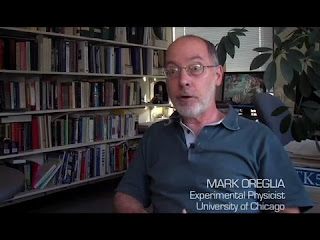
This post is from Mark Oreglia, one of the advisors to "The Atom Smashers".
My colleagues and I loved the film -- not because we were in it, but because of how the filmmakers communicated our arcane subject, and how they were able to focus on the human side of our endeavors. My wife said after the screening "this is the first time I really feel I understand what you do!" So much for my ability to communicate to the public.
The film correctly focusses on competition between various experiments. It is important to understand how important and useful this competition is. Most of the time it is not ugly at all, and it serves to drive us to work harder and produce the best science we can. It also makes sure that results are verified.
I was at CERN last week to attend a workshop on the ATLAS detector, one of the LHC experiments. Two months ago the LHC successfully circulated beams for the first time, so the prospect of bringing the experiments online soon has this place jumping. I was crammed into an office built to comfortably accomodate 4; there were currently 7 people. This is a phenomenon well known to CERN users in the LHC era -- after all, there are nearly 4000 personnel signed on to the 2 main experiments.
Excellent glimpses into life at CERN (at least from the perspective of young people) can be found at here.
Guest post
John Conway writes a guest post. Thanks, John!

When I was first contacted by Clayton and Monica, and invited them out to Fermilab to begin shooting their film, I had in mind at it would be typical science documentary: a sort of voice-of-God "explanation" of our science, what we do, why it's interesting. I could tell on their first visit to Fermilab, though, that they had bigger things in mind. Once I understood what they were after, I tried to hook them up with as many of the people involved in our great quest as I could, people who I hoped would turn out to be interesting on camera.
I have seen the film three times now, and every time I see it I like it better. It really is a unique approach to what could be a very dry and uninteresting topic. (Of course for us physicists it's anything but dry or uninteresting!) The film really captures the spirit of the hunt for the Higgs boson, the excitement and the frustrations. It delves into our lives, our work, and the state of our field.
Hopefully without giving away how the film ends, I can tell you we still have not found any experimental evidence for the Higgs boson. The Tevatron at Fermilab is running amazingly well, we are recording tons of new data every day, and every bit of data brings us a little bit closer to finally seeing the Higgs boson. Next year, the LHC at CERN will start operating for real. It was supposed to have already happened, but in the first two weeks of commissioning, machine suffered a rather serious setback when a string of magnets was damaged by an electrical malfunction. Will this be the break that the Tevatron needed?
Having studied this question for many years now, I think it will still be very hard for the Tevatron experiments to discover the Higgs boson before the LHC, unless the Higgs boson is of the type predicted, for example, by supersymmetry. (That is in fact what I spend my time looking for!) If nature we were that kind, we definitely have a chance to see that at the Tevatron, and as the film shows, we thought we almost had. But hey, you never know...

And what about funding for our field? Happily, we have elected a new president who has promised to try to double the funding for science in the next decade. That would be fantastic except for one quote from the film which keeps coming back to haunt me: it's when Bush's science advisor Jack Marburger intimates that he doesn't foresee funding for high energy physics increasing anytime in the near future. So, it could be that though the rest of science, other fields of physics, enjoy 5-10% increases every year, high-energy physics may not. Time will tell, but I think that we need a major discovery in their field one way or another before our funding levels will increase significantly.
On the home front, as noted at the end of the film, Robin and I (well Robin mostly) had a baby boy in June! Our four month old has made three trips to every lab and one trip to Mexico already, and we are going to Taiwan in December! Yes, his passport photo is very cute. He does take a lot of our time and energy, and we are certain he will be a physicist someday; what other choice could there be?
Tuesday, November 25, 2008
Passing around the hat...
Andrew, our producer, has been hard at work and has put together a great page where you can buy a copy of the film (and, as long as you've got your credit card out, you can donate to our cause to keep the films coming!)
"Can't your budget be diverted?"
We've just gotten a nice write-up in an online publication called "Worldchanging," which operates under the idea that many of the solutions to building a better future are all around us, but just need to be connected. "Informed by that premise," the magazine states, "we do our best to bring you the most important and innovative new tools, models, and ideas for building a bright green future." The writer, Julia Levitt, attended the screening at Vancouver.
The article focuses on one of the issues in the film that appears regularly in our Q & A sessions, and that we expound on in the film at some length: is this worth doing? What's the point of it? Should we care if we find the Higgs boson?
If you haven't seen the film yet, there is a section near the end from a 1979 Donahue show (remember Donahue?) that features Leon Lederman as the guest. Dr. Lederman is featured throughout our film, and is currently nearly as vibrant as he was 30 years ago when he appeared on Donahue. This segment is only a few seconds long, and shows a woman in the crowd standing up to ask a question.

"Hi," she says, "I guess my question is relatively simple. All this money, a hundred million dollars, is that what you said?"
She's referring to an earlier part of the show when Dr. Lederman had mentioned that figure as his lab's budget. There was a visible reaction in the crowd when he stated that figure (remember, this is 1979). Sensing the crowd's unease, he said "does that seem like a lot? Do you know what the military budget is? $100 million buys, I think, one jet airplane." At which point Donahue said "the problem is, you can put the jet airplane in a movie." There's some nervous laughter in the crowd, much of it confused, but Donahue follows up by sharpening the point: "You know what I mean? Then we can all cheer and say 'go, America, and win.'" Then, looking right at Dr. Lederman, he says very directly: "Your work is hard to sell, you know that?"
This point is now being illustrated in no uncertain terms. Donahue quickly answers her question:
"A hundred million. That's just his budget. There are others ---"
"That's just his budget," she says, looking back at Lederman. "Why can't that money be diverted? I feel that cancer research, and other kinds of research are really more important than finding out, you know, just how many quarks make up this world!"

Lederman is watching her with an unreadable expression as she speaks. Behind him is a chalkboard on which he has drawn a rushed diagram of a proton, and finished a (not particularly good) explanation of how a proton is held together. I suspect he is listening to something he has heard a thousand times and has answered hundreds of different ways. Maybe he's thinking he'll never find a way to convince this woman, the audience, or the other people who have expressed similar sentiments, that what he and his colleagues do is worthwhile. Maybe he's thinking that it's not fair to put cancer research and particle physics next to each other on some kind of scale to find out which is more valuable. Or maybe he's thinking it is fair, and doesn't know how to respond. Or maybe he's just tired of talking about it.
in some of the Q&A sessions we've had after the film, the question has come up. So far not in the way that Lederman experienced, but rather from pro-science people wondering how scientists answer this question. We've been asked more than once why we didn't include more information about the ancillary benefits that this type of science generates (after all, CERN invented the world wide web).
The way I respond is to say that our film, while obviously pro-science, is not a science advocacy film. We're not out to prove to you, the viewer, why this kind of science is worth doing. We could trot out a list of all the ways consumer technology or communications technology or even health sciences have benefited from the work people like Dr. Lederman or the other physicists in our film have done. What's far more important, in our minds, is to raise the question. We don't set about answering the question; that's something we feel only the individual viewer can do.
The research that the physicists do in our film as they search for the Higgs boson is called "curiosity-driven" science, or, more simply, pure research. It's knowledge for the sake of understanding. As John Conway says, this is something humans have been doing for 3500 years. That, and that alone, is the way to measure it's worth. And this is exactly where it snags in the fabric of everyday human activity, especially when things seem to be in turmoil. "What good does it do me? Can it cure cancer? Will it make my cell phone better?" To argue that point is, I think, to miss the point. Sure, it might do those things. But more importantly, it has to stand on its own. And many people might find themselves nodding in agreement with the woman from 1979 in the audience of the Donahue show, clearly uninterested in how many quarks make up this world.

In an example of the pleasures I get out of the process of editing, the very next thing you see in the film after the woman from Donahue makes her immanently reasonable statement is Natalie Angier, a science writer from The New York Times. You hear my voice in the background asking "Should we care if the Higgs boson is found?" What follows is one of my favorite moments in the film. Natalie laughs a little, then pauses for a full ten seconds as she tries to figure out how to answer the question. Ten seconds of silence is a long time these days.
Julia's article in Worldchanging addresses this notion. Her first line reads "Is there value in knowledge for the sake of knowledge?" In one of the comments posted at the end of the article, a reader called "sabik" writes
Of course, the problem is how to judge something that won't have a practical application for decades or even centuries. It's a question of what sort of intellectual landscape we are leaving for our children and grand-children - whether it's rich and varied, pregnant with discoveries to be made, or impoverished and bare.
I think this is nicely said. I'll mention something else along these lines that I may have referenced before somewhere in this blog, that addresses head-on the question of the intrinsic worth of "curiosity-driven" science, or pure research. When Robert Wilson (founder of Fermilab) was in congress arguing for the funds that would allow Fermilab to be built, a senator repeatedly asked how Fermilab would contribute to the defense of the country. Finally, exasperated, Wilson said "It will not contribute to the defense of the country. But it will make the country worth defending."
That's Robert Wilson's answer to the question. I wonder if that would have been enough for the woman in the audience?
Subscribe to:
Posts (Atom)
